Good Neighbor Plan and State NOx Budgets
Impacts on Natural Gas Plants and Industrial Boilers, ERC Markets, SCR Upgrades, and Modeling Requirements
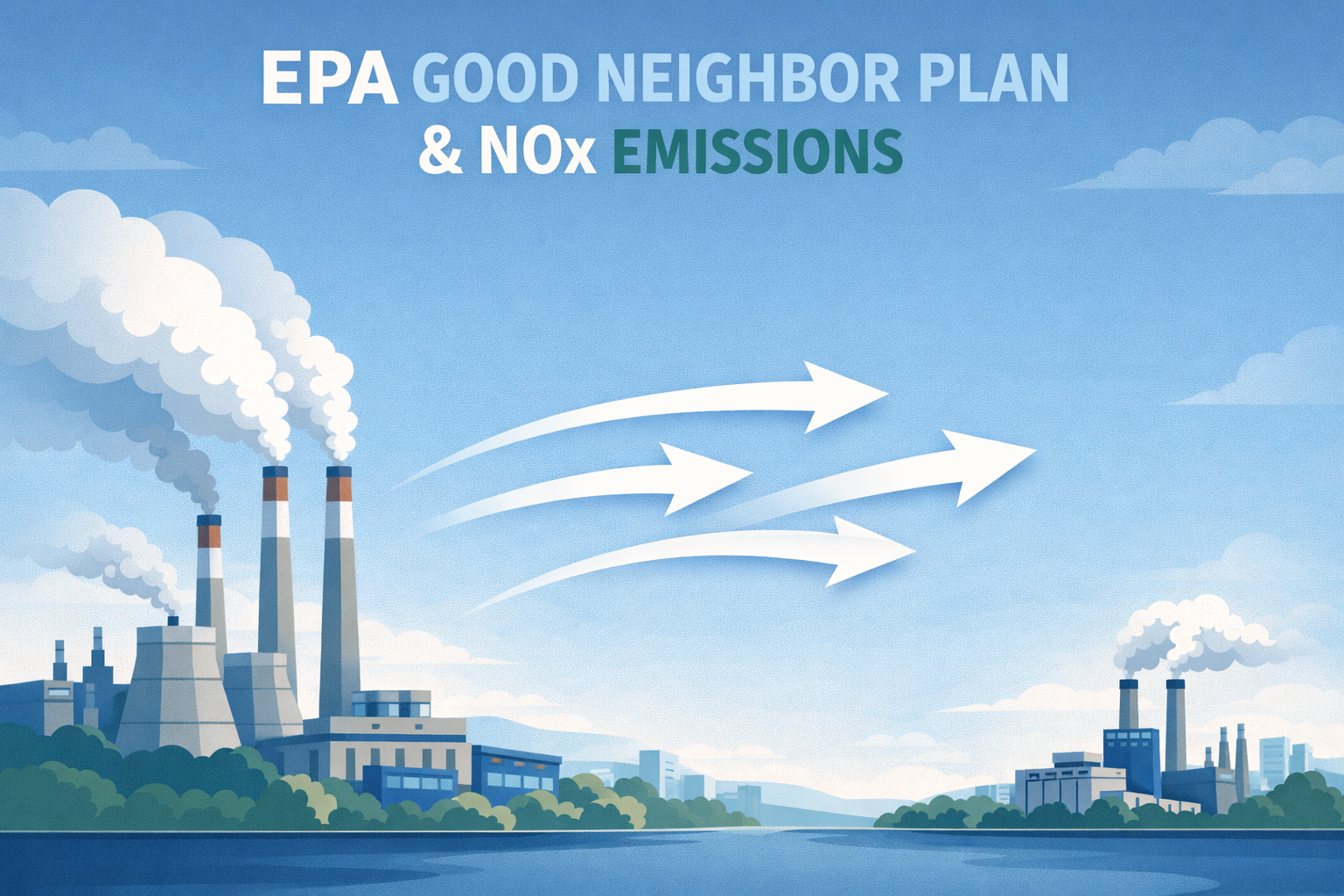
The federal Good Neighbor Plan continues to influence how states address interstate ozone transport, placing increased focus on nitrogen oxides (NOx) emissions from power plants and large industrial sources. While portions of the rule have been subject to legal challenges and recent proposals to modify certain requirements, the broader regulatory direction remains clear. There is ongoing movement toward tighter control of ozone-season emissions and increased emphasis on how those emissions are measured, modeled, and managed.
For owners and operators of natural gas–fired generation and industrial boilers, the implications extend beyond compliance requirements. The evolving regulatory landscape is influencing operating strategies, capital planning, emissions credit markets, and technical documentation expectations.
This reflects a broader shift in how ozone-season emissions are evaluated and managed across state lines, even as specific program elements continue to evolve.
What the Good Neighbor Plan Is Driving
The Good Neighbor framework is intended to ensure that upwind states reduce emissions that contribute to ozone nonattainment in downwind states. Although implementation continues to develop, several core elements are shaping facility-level considerations.
These include the establishment of ozone-season NOx budgets, continued use of trading programs for electric generating units, phased inclusion of certain industrial sectors, and expanded federal involvement where state implementation plans are not approved.
For affected facilities, this is resulting in greater attention to seasonal emissions performance and increased interaction with allowance markets.
Impacts on Natural Gas Power Plants
Combined cycle units and simple cycle combustion turbines that historically operated with flexibility are now operating within more defined compliance expectations during ozone season. This is particularly relevant for peaking units, where high load operation often coincides with the conditions that contribute to ozone formation.
Facilities that have relied on low-NOx burners or annual average performance are increasingly evaluating how emissions vary during peak conditions. Short-duration increases in emissions can be more significant when assessed in a seasonal or hourly context.
Selective catalytic reduction systems remain a primary control technology. Many systems, however, were designed to meet earlier regulatory requirements. As expectations evolve, facilities are evaluating catalyst condition, ammonia distribution, temperature management, and data quality to support consistent performance under a range of operating conditions.
Operational planning is also incorporating emissions considerations more directly. The cost of NOx allowances is becoming one of several factors considered alongside fuel costs and power market conditions.
Impacts on Industrial Boilers
Industrial boilers in sectors such as cement, steel, and glass are also subject to increasing attention under evolving federal and state programs. Facilities without advanced controls may be evaluating potential upgrades, while those with existing controls are focusing on demonstrating consistent performance during varying production levels.
This often involves developing a more detailed understanding of how emissions respond to changes in load and operating conditions. Facilities with well-documented emissions data and control performance are generally better positioned during permit renewals and modifications.
As expectations continue to develop, there is increased emphasis on consistent monitoring, documentation, and alignment between production and emissions performance.
Effects on ERC and Allowance Markets
Emission Reduction Credit markets and ozone-season allowance programs continue to evolve alongside regulatory developments. Market conditions are influenced by generation patterns, renewable energy penetration, fuel prices, and differences in state-level implementation.
Facilities that have historically generated excess allowances may see changes in that position, while others may experience variability in allowance needs during peak ozone periods. As a result, emissions forecasting is becoming an important component of planning. Understanding how operational scenarios translate into emissions and allowance requirements supports more informed decision-making.
Modeling and Documentation Requirements
The current regulatory environment is also associated with increased expectations for modeling and technical documentation. Regulators are placing greater emphasis on data quality, transparency, and the ability to support conclusions with clear analysis.
Facilities may need updated dispersion modeling for permit actions, ozone-season emissions projections under different operating scenarios, and documentation demonstrating control system performance. Detailed emissions inventories and consistent hourly data records are increasingly important in both permitting and compliance contexts.
For new projects or capacity expansions, demonstrating that emissions will not contribute to downwind nonattainment requires careful modeling and well-supported assumptions.
Capital Planning and Risk Management
The evolving nature of ozone transport regulations is influencing how facilities approach capital planning and risk management. Facilities are evaluating whether existing controls can meet expected ozone-season performance, how allowance costs may affect operations, and how to plan for potential future regulatory changes.
For organizations with assets across multiple states, these considerations may vary by location, requiring coordinated strategies that account for both regulatory and market conditions.
Practical Steps for Facility Owners
Facilities are taking a range of steps to better understand and manage ozone-season performance. These include developing emissions forecasts using historical data, evaluating control performance under peak conditions, and assessing potential allowance needs under different operating scenarios.
Many are also reviewing permits for potential modification triggers and strengthening data collection and documentation practices in advance of regulatory review.
The Bottom Line
The Good Neighbor Plan and evolving state NOx programs are continuing to shape how ozone-season emissions are managed, even as specific requirements develop over time. Natural gas plants and industrial boilers remain important to energy reliability and industrial activity, while operating within increasingly defined seasonal expectations and technical requirements.
Facilities that focus on data quality, control system performance, and forward-looking planning are better positioned to manage both regulatory obligations and operational considerations in a changing environment.